

The Lowdown on Choosing the Perfect Modern Living Room Rug Color for 2026
A modern living room rug should be more than just a pretty face. It should tie the whole room together – your sofa, flooring, furniture, and colour palette – or else it risks making an otherwise well-designed space start to feel kind of… disconnected.
When it comes to rug colours for 2026, the top contenders fall under warm neutrals, earthy browns, soft ivories, muted greens, deep blues, and some carefully chosen statement colours. But the best choice is anything but a no-brainer – it all depends on your room’s fixed elements, lighting, sofa colour, rug size, and what the heck – what’s trending right now just isn’t the whole story.
What Style of Rug Will Work Best for My Modern Living Room?
For most modern living rooms, start with the basics – get the right rug size for your seating area, then take a gander at your floor and sofa undertones before deciding on a colour. Warm neutrals and textured designs are pretty safe bets for long-term flexibility, but if you’ve got simple furniture and not too many other patterns competing for attention, geometric or abstract patterns can really make a room pop.
That’s the CliffsNotes version.
But here’s the thing: a beautiful rug can still be the entirely wrong rug for your home.
A beige rug under a nice beige sofa might look pretty snazzy. Or, you know, it can just disappear into thin air. A bold geometric rug can add a ton of personality to a plain room. But place that same rug under a patterned sofa, some fancy curtains, and some real eye-catching artwork, and the whole space starts to feel like it’s missing a beat.
So don’t go choosing the colour first.
Think about which visual problem your room needs solving first.
The Best Rug Colours for Modern Living Rooms in 2026
For 2026, the best rug colours aren’t just about going with what everyone else is doing. No way. The current vibe is all about warm neutrals, tactile, natural-looking surfaces, earthy shades, muted contemporary palettes, and using richer statement colours in a pretty thoughtful way.
Warm Beige, Cream, and Ivory for Flexible Modern Interiors
Warm neutrals remain some of the safest picks for area rug colours, because they work with pretty much anything – new furniture, new décor, whatever.
- Cream
- Ivory
- Sand
- Oatmeal
- Warm Beige
- Soft Taupe
These work especially well when you’ve got wood furniture, layered textures, or a neutral sofa. The key is the undertone, though. A cool grey floor paired with a yellow-beige rug might look kinda weird, or a warm wood floor paired with a blue-grey rug might be intentional contrast – but only if the rest of the room is on board.
If you’re after one of the easiest neutral rug ideas, try a warm neutral with some visible texture or a subtle tonal pattern. You get depth without adding another dominant colour.
Brown and Earthy Shades Create a More Grounded Look
Brown is a lifesaver when a modern room starts to feel too cold, too white, or just too… polished.
Soft chocolate, camel, mushroom, and earth-inspired tones bring some real weight to a seating area, and work naturally with wood, leather, black accents, and organic materials. Just don’t go overboard – a small room with limited natural light can get heavy if the rug and sofa and floor are all dark. Use deeper shades when you want the rug to anchor a larger seating arrangement or create some clear contrast with lighter furniture.
Muted Green is a Great Choice for Modern Organic Interiors
Sage, olive, moss, and other muted greens are a great choice for homeowners looking for a bit of colour without going all out for a bright statement rug.
Green works especially well when paired with:
- Warm wood
- Cream upholstery
- Black metal accents
- Natural fibres
- Earth-toned decor
A muted green rug can add some real character to a modern living room, and is usually easier to coordinate than highly saturated colours. Just be careful with it if you’ve got a bold sofa – a room doesn’t need everything asking for attention.
Blue Remains a Dependable Choice for a Modern Living Room
Blue can go a few different ways.
A soft blue-grey rug can support a calm, contemporary space. Navy creates some real contrast and visual weight. A multi-tone blue pattern can bridge a neutral sofa with blue accents elsewhere in the room.
The key is to avoid matching the sofa exactly. If your sofa is navy, a rug with navy, plus some cream, grey, or a secondary accent colour is usually going to create more depth than a solid navy rug.
Rich Statement Colours Need the Right Room
Deep terracotta, rust, forest green, burgundy, and other saturated colours can make the rug a real focal point.
Just remember: if the rest of the room is pretty quiet, then a statement rug will work. If your sofa is patterned, your curtains are colourful, and your walls are displaying some real busy artwork, adding another strong pattern or colour is usually just gonna add to the noise.The more visual activity you already have in the room, the quieter your rug should be.
And the exact opposite is true.
A plain sofa, some simple walls, and not too much other furniture give you a lot more freedom to choose a pretty dramatic rug.
How to Choose a Rug Color for a Living Room: Try This Different Order
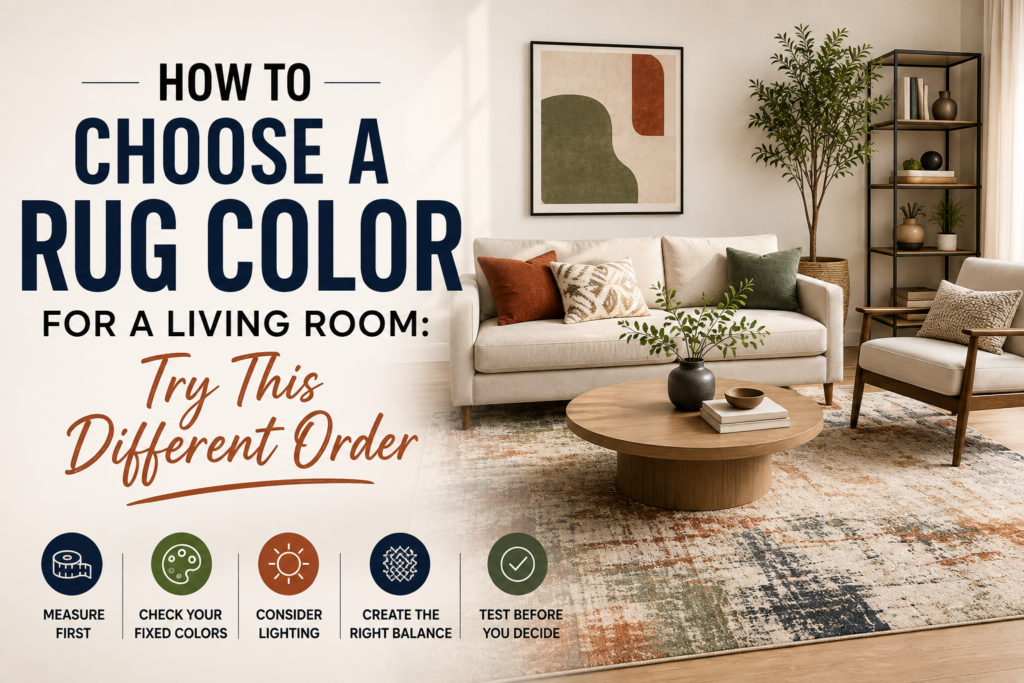
Lots of people shop for rugs all wrong.
They see a colour they like. Then they try to make it work in the room.
Try doing it the other way round instead.
Step 1: Choose the best area rug size for your living room before you even think about the colour
Before you start worrying about whether to go for ivory, sage, blue or terracotta, get out your tape measure and figure out what size rug you can actually fit in your room.
A rug that’s too small can make the furniture look like it’s floating around with no connection to the floor. And lets be real – that’s one of the main reasons we buy area rugs in the first place – to create a cohesive look. A common trick is to arrange your furniture layout so that at least the front legs of all the big seaters are on the rug. And in bigger rooms, you can go all out and cover the whole conversation area. Just don’t get sucked in to buying an 8×10 just because it sounds like a good size – measure your furniture arrangement, not just the empty floor space.
Measure the furniture, take into account the empty space between bits, and then choose a rug based on that.
Step 2: Think about the colours you can’t change
First off, think about the big stuff you can’t change:
- Flooring
- The big sofa
- The wall colour
- Built-in cupboards
- Fireplace materials
These surfaces are already dominating the visual landscape in your room, so they should guide your decision. But what’s the vibe? Does your room lean warm, cool or somewhere in between?
For example, a warm oak floor, cream sofa and brass accents are one thing. But a grey tile floor, charcoal furniture and chrome details are something else entirely. You don’t need everything to match perfectly, but you do need the undertones to work together.
Step 3: Decide whether the rug should calm the room down or give it a bit of zing
This is the part that lots of people miss out on.
Take a good hard look at your room and ask yourself: if the sofa, art, pillows, and furniture are already pretty busy, go for a calming rug colour and texture. Tonal neutrals, subtle textures or low-contrast patterns will give your eye somewhere to rest.
But if the room feels a bit bare and needs a bit of extra oomph, then your rug can really do some work. Go for a bolder colour, a geometric design, abstract pattern, or multi-coloured composition.
The rug should be the thing that fills in the gaps in your room – not just something that matches the sofa exactly.
Step 4: Create contrast, rather than going for a perfect match
So, should your rug match your couch exactly?
No, not necessarily. It’s okay if they’re in the same colour family or undertone, but if they’re identical, the room just ends up looking flat. You want to create a bit of separation between the furniture and the floor plane, while still keeping the whole thing looking cohesive.
For example:
- A cream sofa: try for a taupe, sage, muted blue or multi-tone neutral rug – something a bit different from the sofa.
- A grey sofa: first figure out if the grey is warm or cool, then choose the rug accordingly.
- A dark sofa: go for a lighter-coloured rug to create some contrast.
- A beige sofa: avoid a rug that’s almost identical to the sofa – unless you can get some nice texture or pattern on the rug to set it apart.
The goal is to coordinate the look, not to make the rug invisible.
Step 5: Make sure the colour looks good in real life – not just in a photo
This is the one that saves you from buying a rug that looks great in a studio, but completely different in your actual home lighting.
Check out samples or product swatches in the room, and see how they look at different times of day. Look at them next to the sofa, the flooring – the whole shebang. And don’t make the final decision based on one photo.
The Best Rug Patterns for a Modern Living Room: What to Look For
The best rug patterns for living rooms depend less on what’s trendy and more on how busy the room already is.
Modern area rug styles are super varied these days, ranging from subtle textures and tonal designs to geometric forms, abstract compositions, vintage-inspired looks, natural materials, and really eye-catching contemporary patterns.
Geometric pattern rugs work well in rooms with a minimalist vibe
Geometric rugs are best in rooms with:
- Clean lines and minimal pattern on the furniture
- Plain upholstery and a simple colour scheme
- Not too much wall decoration
- Simple furniture shapes and minimal embellishments
They add a bit of structure and rhythm, which can really help to create a cohesive look.
But if you go for high-contrast geometric patterns, they make a much bigger statement. If you prefer something more subtle, choose a low-contrast design and you’ll get a nice pattern without making the floor the main event.
Abstract patterns add movement and interest without being too rigid
Abstract rugs are perfect if you want a bit of a focal point in the room, but don’t want a super strict geometric pattern.
They work especially well in rooms with curved furniture, sculptural coffee tables and softer interior styles.Look for colours that are already lurking elsewhere in the room – even a small repeated accent can make the rug feel connected rather than just being plonked in there.
Tonal and Textured Rugs Are Quietly Stealing the Show in Modern Interiors
You don’t have to have a solid coloured rug to avoid looking flat.
A little texture, high/low pile, some woven variation or subtle tonal shifts can add loads of depth without introducing another busy pattern into the mix.
That’s one of the reasons a textured rug is a top choice for minimalist interiors – you get visual interest without the room losing its calm vibe.
A Simple Rug Pattern Rule That Most of Us Can Follow
Use this before buying and you might avoid the rug regret:
Busy room = quieter rug. Simple room = go wild with pattern.
If you’ve already got a patterned sofa, colourful curtains or some bold artwork, pick a rug that’s a bit more subdued.
But if your living room has plain furniture and a restrained colour pallet, then a geometric, abstract or artistic rug can be the feature that really gives the room its personality.
Pattern scale is also important.
A big pattern is way easier to read across a bigger room. Smaller, more intricate patterns can add loads of texture but can get a bit too busy when repeated across a large rug.
Don’t choose a rug just because it looks epic in a close-up product image.
Picture it taking up a big chunk of your floor and decide then whether that pattern really works.
Modern Living Room Rug Ideas – Sorted by Room Type
Small Modern Living Rooms
Pick a rug that ties the seating area together without making the room feel any smaller.
Light or medium neutrals, low-contrast patterns and softer textures are a good starting point. A very dark, high-contrast rug can take over a compact room if the rest of the space is already pretty dark.
And don’t even think about getting a tiny rug – it’ll just look silly in a small room.
Large Open-Concept Living Rooms
Use the rug to define the seating area.
A bigger rug with a deeper colour or stronger pattern can actually work really well in a space this size because the room has plenty of visual space to absorb it. And with more room to play around, you might be able to get away with having all furniture legs on the rug.
The rug starts to feel like part of the room’s architecture.
Neutral Modern Living Rooms
This is the bit where most of us either play it too safe or try to overcorrect.
You’ve got two good choices:
Go for a textured neutral rug for a really understated, layered look.
Or introduce a bit of controlled colour through the rug – muted green, blue, rust or another tone that you already have in smaller accents.
Don’t just add loads of colours because the room feels boring – one intentional move is way stronger than lots of random ones.
How Carpitzi Can Help You Find the Right Rug
Buying modern living room rugs online can be a bit overwhelming when you’re looking at dozens of designs.
Start by thinking about your room, not the product catalog.
At Carpitzi, shoppers can narrow down their options by thinking about the required rug size, then checking out options in their favourite colour family, pattern and style. That’s a much more practical way to shop than just starting with a random product image and hoping it works out at home.
Here’s a useful Carpitzi buying process to follow:
First: measure the seating area.
Then: decide whether your room needs a neutral foundation or a statement piece.
Next: compare the rug colours with your sofa and flooring.
Finally: choose the pattern level – textured, tonal, geometric, abstract or a bit more expressive.
After that, review the product’s material, pile, construction and care requirements based on how your household actually uses the living room.
If you’ve got kids, pets or a household with a lot of foot traffic, your buying decision should be about maintenance and durability, not just colour.
Current 2026 rug buying guides are starting to distinguish between decorative preferences and practical needs like traffic, cleaning and ease of maintenance.
A bold statement rug is not the right choice for everyone.
Neither is a pale ivory rug.
The best purchase is the one that fits your room’s dimensions, visual balance and daily use.
FAQs About Modern Living Room Rugs
1. What colour rug is best for a modern living room?
Warm neutrals like ivory, beige, taupe and earthy brown are pretty versatile choices for modern interiors. Muted green and blue also work well when the room needs a bit of colour. Choose based on your sofa, flooring, undertones and lighting rather than following the latest trend.
2. What are the best rug colours for living rooms in 2026?
Warm neutrals, earthy browns, muted greens, soft contemporary blues and the odd stronger statement colour are all strong directions for 2026. Textured and tonal designs are also really popular in contemporary rug styling right now.
3. Should a living room rug be lighter or darker than the sofa?
A slight contrast often creates more depth than having everything match perfectly. A lighter rug can do a great job of balancing out a dark sofa, while a deeper rug can actually ground some lighter furniture. The choice all comes down to the floor, walls, and amount of natural light in the room.
4. Should the rug match the sofa?
Absolutely not. The rug should coordinate with the sofa without being a carbon copy of it. It’s the shared undertones and repeated accent colours that create cohesion, but a bit of contrast stops the seating area from looking flat and boring.
5. What are the best rug patterns for a modern living room?
Geometric, abstract, tonal, textured and contemporary patterns all work surprisingly well in a modern living room. The thing is though, you want to choose a quieter rug for a room that’s already visually quite busy and go with a stronger pattern for a room that’s nice and simple.
6. Are geometric pattern rugs good for living rooms?
Yeah they are. Geometric pattern rugs work especially well when you’ve got clean-lined furniture and plain upholstery. It’s a good idea to go with a lower-contrast geometric design if you want a subtle modern look – or go bolder when you want the rug to be the focal point.
7. What is the best area rug size for a living room?
Well the best size all depends on your seating layout. Get out the tape measure and measure out the furniture arrangement first, then choose a rug that’s big enough to visually tie the seating together. A common approach is to put at least the front legs of the major seating pieces on the rug.
8. How do I choose a rug colour for my living room?
Start by taking into account your fixed elements – the flooring, sofa, walls and any major finishes. Try to work out if the room’s got warm or cool undertones, decide whether you want the rug to calm the space down or give it a bit of energy, and check out the final colour in the actual lighting – not just the lighting you’ve got set up in the morning.
9. What rug colour makes a small living room look bigger?
If you’ve got a small living room, light to medium neutrals can really help it feel a bit more open, especially if the room hasn’t got a lot of natural light coming in. Just watch out not to choose an undersized rug – scale is just as important as colour.
10. What is the safest rug choice if I plan to change my furniture later?
The safest bet if you know you’re going to be changing your furniture around pretty frequently is a warm neutral or multi-tone rug with a subtle texture. These designs can fit in with loads of different looks without you having to rip the whole room apart and start again.
Choose the Rug After You Understand The Room
To be honest, the best modern living room rug is completely not going to be automatically beige, geometric, blue or patterned. It’s worth starting by looking at the seating area and working out the correct size – then getting a feel for the undertones in the floor and sofa. Decide whether the room needs some calm or a bit more contrast, then choose a colour and pattern that solves that specific problem.
Browse Carpitzi with those decisions already made – and you’ll save a lot of time scrolling through rugs that were never actually the right choice for your room in the first place. And you’ll have a much better chance of choosing one that still looks good after the initial rush of buying it wears off.


