

Choosing the Right Rug Size for Your Living Room
The whole 8×10 vs 9×12 rug thing essentially comes down to one thing: coverage. An 8×10 rug is usually a good fit for smaller to medium-sized living rooms. A 9×12 rug on the other hand is generally better suited for larger rooms and bigger furniture layouts.
If you’re still trying to decide between the two, ask yourself: do you want just the front legs of your furniture to be on the rug, or do you want most of the seating area to be sitting pretty on it?
A rug that’s too small can really make a room look disjointed, whereas a large rug that’s properly sized can help define the seating zone and make the whole room feel more intentional.
Size Matters
Rug size has a huge impact on the overall look and feel of your living room. It’s not just a decorative afterthought that sits under the coffee table – it helps to organize the furniture and create a sense of balance in the space.
Think of your rug as the foundation of the room. If that foundation is too small, everything around it starts to look a bit off kilter, as if it’s floating on a cloud. And yes, even that expensive sofa can start to look a bit lost.
Design experts often advise leaving some of the floor exposed around the edges of the room, rather than going for a wall-to-wall rug. The exact amount depends on the room’s dimensions, but generally speaking, some visible flooring is a good thing.
A well-chosen rug can help to:
- Create a clear focal point
- Connect the sofas, chairs and coffee tables
- Bring warmth and texture into the space
- Improve the overall visual scale of the room
- And, of course, make an open-plan space feel more organized
And the best way to choose the right rug size? Measure up, and don’t just guess from a website thumbnail – that’s not exactly going to give you an accurate idea of the size.
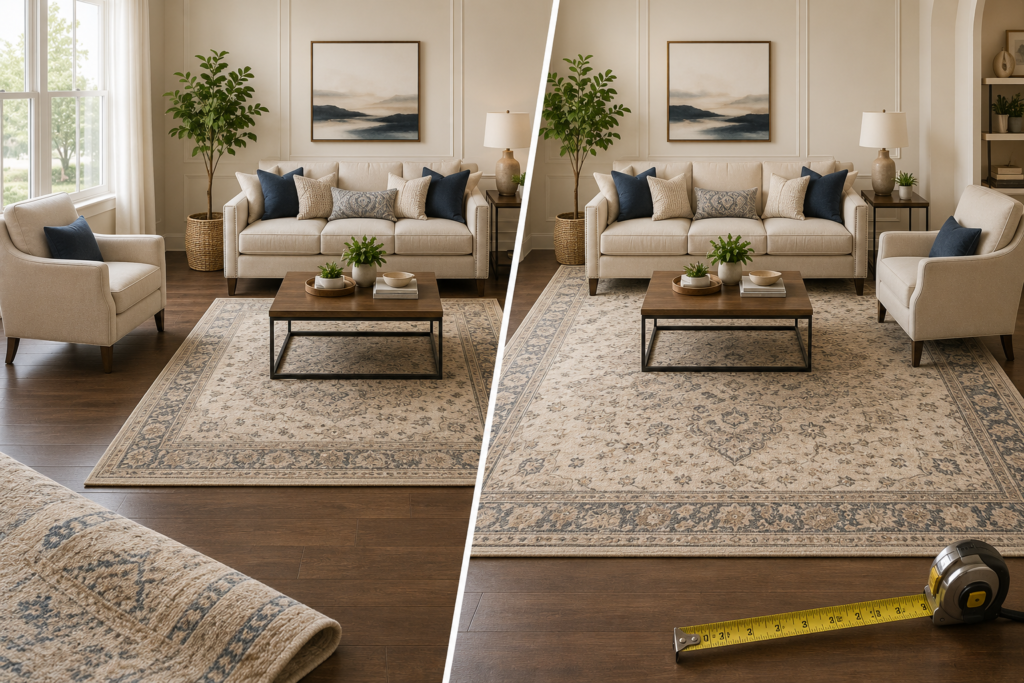
What’s The Difference Between an 8×10 and 9×12 Rug, Really?
Size Matters – The Actual Difference
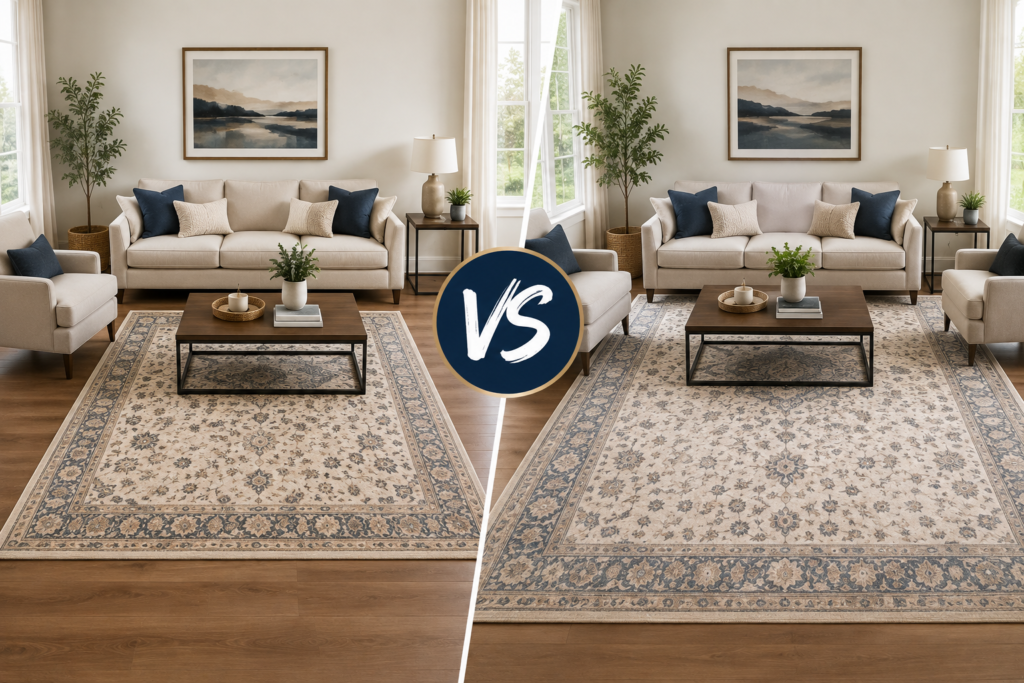
So how big is that difference between an 8×10 and 9×12 rug really? It’s actually a pretty big deal. A 9×12 rug covers 108 square feet – that’s 28 more square feet than an 8×10 rug, which only manages a total of 80 square feet.
That extra space can make all the difference to how your furniture sits on the rug.
Rug Dimensions – A Quick Guide
8×10 Rug Dimensions
- 8 feet wide
- 10 feet long
- total coverage: 80 square feet
9×12 Rug Dimensions
- 9 feet wide
- 12 feet long
- total coverage: 108 square feet
The 9×12 is one of the most popular large area rug sizes because it provides just the right amount of coverage for larger seating arrangements without going too far and covering the whole floor.
Can an 8×10 Rug Really Work in a Living Room?
Yes, an 8×10 rug can work perfectly in a living room, especially if the room is on the smaller side or if your furniture arrangement doesn’t need every piece to be fully on the rug.
For many standard-sized living rooms, an 8×10 rug is a great choice because it allows the front legs of the sofa and chairs to be on the rug while the back legs are still on the floor.
This arrangement can create a nice, cohesive look without using too much floor space.
When an 8×10 Rug Is a Good Choice
- Your living room is small to medium-sized
- Your sofa is snuggled up against a wall
- You’ve got a compact sectional
- You want to leave some exposed flooring
- Your seating arrangement is relatively shallow
- You’re on a smaller budget
And a great little tip for when you’re trying to decide: use some painter’s tape to mark out an 8×10 rectangle on your floor, walk around it and see where your sofa, chairs and coffee table would sit. It’s a simple test, but it’s way more reliable than trying to imagine the size from a website image.
When Does a 9×12 Rug Make More Sense?
A 9×12 rug is often the better choice for larger living rooms or open-plan spaces that need a bit more oomph. The extra real estate gives you way more flexibility when it comes to placing your furniture around the room.
In a lot of layouts, a 9×12 rug can do the job of anchoring the front and back legs of a sofa – or let’s you get multiple seating pieces to sit mostly on the rug.
This does a great job of creating a stronger visual connection between the furniture that’s making it feel like one big, cohesive piece.
Choose a 9×12 Rug If:
- You’ve got a big, open-plan living room
- You own a massive sectional sofa
- You use multiple chairs around the seating area to create different conversation zones
- Your furniture is spread out away from the walls
- You want a more luxurious and grounded look
- Your coffee table and seating arrangement need more coverage
The main advantage of a larger rug is that you get more room to move furniture around without making the whole seating area look cramped.
For homeowners looking at the different large area rug sizes, a 9×12 is often a practical option because it can really anchor a complete living room arrangement.
Which Rug Size Works Best For Your Living Room Layout?
The best choice really depends on how much floor space your furniture takes up, rather than the room’s square footage alone. Measure the seating area first, then compare that footprint with the rug dimensions.
Here are the most common living room layouts we see.
Sofa Against the Wall
If your sofa is stuck against a wall, an 8×10 rug can work really well. Place the rug so the front legs of the sofa are sitting on it, stretching into the main seating area.
This creates a nice connection without needing the rug to go all the way under the sofa.
A 9×12 might also work, especially if you’ve got a bigger sofa or some additional chairs.
Best general choice:
- Compact room: 8×10 works best
- Spacious room: 9×12 is often the way to go
Floating Furniture Layout
If the sofa and chairs in your living room are floating in the center of a big room, away from the walls, then a 9×12 rug is usually the better choice because the furniture needs a bigger foundation.
If you put a small rug under floating furniture it can make it look disconnected – like it’s not really part of the conversation area.
The rug should visually support the entire seating area. A 9×12 rug can provide that extra bit of support.
Best general choice: 9×12
Sectional Sofa Layout
Sectionals can make choosing the right rug size a bit tricky, because their L-shape takes up a lot more floor space than you’d expect.
For a compact sectional, an 8×10 might work if you position it right under the front of the furniture. For a bigger L-shaped or U-shaped sectional, a 9×12 often gives you the better coverage.
Before you buy, measure out the length and width of your sectional.
Best general choice:
- Small sectional: 8×10 might just do the job
- Large sectional: 9×12 is probably a safer bet
Sofa & Two Accent Chairs
This layout is popular because it creates a clear conversation area. The rug should tie all three major seating pieces together.
An 8×10 can work if the furniture is nestled all snug and tight together. However, a 9×12 gives you a lot more flexibility if the chairs are a bit farther away from the sofa.
Best general choice: depends on the spacing, but 9×12 is often the way to go in a bigger seating zone.
How Much Space Should Be Between a Rug and the Walls?
You generally don’t want your living room rug pressed up against every wall. Leaving a bit of visible flooring shows off around the rug helps create visual balance.
The ideal spacing really varies on the room size, architecture and furniture layout.
As a general rule of thumb, leave enough exposed flooring to create a clear border around the rug. In smaller rooms that border might be narrower, but in bigger rooms you can leave more visible flooring while still looking good.
The key is to keep it consistent – don’t have the rug leaving a huge amount of empty space on one side but barely reaching the wall on the other. That just looks accidental.
Before you buy, map the rug on the floor using painter’s tape.
Simple Measurement Method
- Measure the length and width of your living room.
- Measure your sofa and major chairs.
- Mark an 8×10 rectangle using tape.
- Take a walk around the room and check the pathways.
- Do the same with a 9×12 rectangle.
- Choose the layout that looks balanced and leaves some comfortable circulation space.
This gives you a more realistic view of what it’ll look like before you invest in a new rug.
8×10 vs 9×12 Rug: Which One Makes a Room Look Bigger?
A bigger rug can make a room look more unified, which can sometimes make the space look bigger too. But bigger is not automatically better.
The right size of rug is the one that fits the furniture layout and the room proportions.
An undersized rug can make the seating area look smaller because it just doesn’t connect the furniture. A larger 9×12 rug can often make a big room feel more cohesive.
But if a 9×12 leaves almost no visible flooring or blocks the natural walking space, it can overwhelm a smaller room.
For Small Living RoomsAn 8 by 10 may give you a better balance. It gives you a lot of coverage while still letting you see the flooring around the seating area.
For Large Living Rooms
A 9 by 12 often works better because it stops your furniture from looking scattered all over a big open floor.
So the real rule is simple: Pick the largest rug size that fits your furniture layout comfortably without making the room feel cramped.
What Are the Most Common Rug Sizing Mistakes?
The most common mistake is buying a rug based on how it looks online. The pictures on product websites can be helpful, but they dont often match the exact dimensions of your living room.
Here are several mistakes you should try to avoid.
1. Choosing a Rug That Is Too Small
A rug that only goes under the coffee table may look more like an accent than the foundation of a living room.
Ideally the rug should connect at least some of the major furniture pieces if it can.
2. Ignoring Furniture Dimensions
Dont just measure the room. You need to know your sofa depth, where your chairs are going and how big your coffee table is, all of those things affect the rug you need.
3. Forgetting About Walking Paths
A larger rug shouldnt create awkward traffic patterns around the room. Make sure doors can still open and people can move around comfortably.
4. Buying Before Testing the Size
Painter’s tape is cheap. Returning a heavy area rug is a right pain.
Testing the dimensions on the floor can stop you from making a costly sizing mistake.
5. Focusing Only on Price
A bigger rug might be more expensive because it uses more material and takes more work to make. But buying a rug that is too small and having to replace it later is not exactly a budget-friendly move.
Think about the size that works best for your room in the long run.
How Do You Choose the Best Rug Size for Your Living Room?
Start by measuring your furniture arrangement rather than just making an educated guess based on some preconceived idea of what a “small” or “large” room looks like.
A room can have plenty of square footage and still have a compact seating area. Another room may be smaller but have a massive sectional.
Use this three-step approach.
Step 1: Measure the Seating Area
Measure the full width and depth of your main seating area.
Include:
- Your sofa
- Your sectional
- Accent chairs
- Side tables if theyre a part of the grouping
You dont necessarily need every single furniture leg on the rug but the rug should relate in proportion to the whole setup.
Step 2: Work Out Your Furniture Layout
Choose one of these approaches:
Rug going under front legs:
Often works well with an 8×10 rug.
Most of your furniture on the rug:
Often requires a 9×12 rug.
All of your major furniture fully on the rug:
Usually works best in bigger rooms with enough floor space.
Step 3: Check Your Clearance
After youve marked out the size of your rug, check:
- Any walking space that might be affected
- Whether your doors still open
- How close you are to your walls
- If it looks visually balanced
- Where your furniture is placed
If the 9×12 rug feels too big, the 8×10 might be a better fit. And if the 8×10 makes your seating arrangement feel disconnected, size up.
8×10 vs 9×12 Rug Comparison Chart
| Feature | 8×10 Rug | 9×12 Rug |
| Total Coverage | 80 sq. ft. | 108 sq. ft. |
| Best For | Small to medium rooms | Medium to large rooms |
| Furniture Placement | Front legs often fit | More furniture can fit |
| Visual Effect | Balanced and compact | Grounded and expansive |
| Works With Large Sectionals | Sometimes | Often |
| Floor Space Left Visible | More | Less |
| Budget Consideration | Usually lower material requirement | Usually higher material requirement |
| Best For Floating Layouts | Limited in large layouts | Often a better fit |
Are 8×10 and 9×12 the Only Large Area Rug Sizes?
No theyre not. These are just two of the most popular sizes, but there are lots of other large area rug sizes that might suit different rooms and furniture arrangements.
Some of the more common sizes include:
- 5×8
- 6×9
- 8×10
- 9×12
- 10×14
- 12×15 and bigger
The right one for you will depend on the room, the size of your furniture and how you want it all to look.
For example, a very large room with an open living area might need a 10×14 rug rather than either of the other two.
Dont try to force your room into a standard size just because its popular. You want to get the proportions right.
How Do You Choose a Rug Material After Youve Picked the Size?
Once youve decided between an 8×10 and a 9×12, the next thing to think about is the material.
A rug’s material affects how it looks, how tough it is, how hard it is to clean, and how it feels under your feet.
Wool
Wool rugs are well known for their natural texture and durability, theyre a great choice for living rooms because they add warmth and visual depth.
Hand-Tufted Construction
Hand-tufted rugs have a detailed, textured look and are often available in a wide range of modern and traditional designs.### Flatweave Rugs
Flat weaves can be super practical for casual spaces because they’re pretty low-key, and so can work great where door clearance is tight.
The best material really depends on your household – how much traffic you’ve got, how often you need to clean it, and what kind of style you’re after.
If you’ve got kids, pets or a super busy living room, you need to think about the maintenance before you choose a design. A rug should work with your lifestyle – not become another job on your to-do list.
Final Verdict: 8×10 vs 9×12 Rug – Which One Should You Get?
Choose an 8×10 rug if you’ve got a small to medium sized living room, a compact furniture arrangement or want to show off a bit more of the floor around your furniture.
Go for a 9×12 rug if you’ve got a bigger room, a big sectional or multiple seating areas. Or if you just want the rug to tie it all in and make the space feel more complete.
For most people comparing an 8×10 and 9×12 rug, the key is measuring the seating area first.
Here’s a Simple Little Rule:
Go with 8×10 if:
Your furniture is pretty compact and the front legs of your main seating pieces can sit on the rug nicely.
Go with 9×12 if:
You’ve got a big seating area and want to make sure more of the furniture feels connected and solid.
Before you order, mark both sizes on your floor, take a step back and have a look. Sometimes the right choice feels obvious the moment you do.
Ready to find your perfect fit? Browse Carpitzi’s 8×10 and 9×12 rug collections, and choose a big one that fits your living room – not just your wish list.
FAQs:
1. Is an 8×10 or 9×12 rug better for a living room?
A 9×12 rug is generally better for a larger living room, while an 8×10 rug works well in small to medium-sized spaces. The best choice depends on your furniture layout, room dimensions, and how much of your furniture you want placed on the rug.
2. Is a 9×12 rug much bigger than an 8×10 rug?
Yes. A 9×12 rug covers 108 square feet, while an 8×10 rug covers 80 square feet. This means a 9×12 rug provides 28 additional square feet of coverage, giving you more space for sofas, sectionals, and accent chairs.
3. What size living room is best for an 8×10 rug?
An 8×10 rug is usually best for a small to medium-sized living room with a compact furniture arrangement. It works especially well when the front legs of the sofa and chairs can rest on the rug while maintaining comfortable walking space around the room.
4. What size living room is best for a 9×12 rug?
A 9×12 rug is ideal for medium to large living rooms or open-concept spaces with larger furniture. It provides enough coverage to anchor a sectional, sofa, accent chairs, and a coffee table in one visually connected seating area.
5. Should all furniture legs be on a living room rug?
No, all furniture legs do not need to be on the rug. In many living rooms, placing the front legs of sofas and chairs on the rug creates a balanced and connected look. Larger rooms may benefit from having most or all major furniture on the rug.
6. How do I know if an 8×10 rug is too small for my living room?
An 8×10 rug may be too small if it only sits under the coffee table and does not connect the surrounding furniture. Before buying, mark the 8×10 dimensions on your floor with painter’s tape to see whether the sofa and chairs fit proportionally.
7. Can a 9×12 rug make a living room look bigger?
Yes, a properly sized 9×12 rug can make a large living room feel more unified and visually spacious by connecting the furniture into one defined seating area. However, it should still leave enough space around the edges for comfortable movement and balanced proportions.
8. Which rug size is better for a sectional sofa: 8×10 or 9×12?
A 9×12 rug is often better for a large sectional sofa because it provides more room to anchor the entire seating arrangement. A smaller sectional may fit well with an 8×10 rug, so measuring the sectional’s length and depth is important before choosing.
9. How much floor should be visible around a living room rug?
The amount of visible floor space depends on your room size and furniture layout. As a general rule, leave a consistent border of exposed flooring around the rug so the room feels balanced rather than overcrowded. Always check walking paths and door clearance before selecting a large area rug.
10. How can I choose the best rug size for my living room before buying online?
The easiest way is to measure your living room and mark the rug dimensions on the floor using painter’s tape. Test both 8×10 and 9×12 dimensions, check furniture placement and walking space, and choose the size that best anchors your seating area without overwhelming the room.


